

Breeding for Better Rotations Opens a New Frontier in Farming Systems
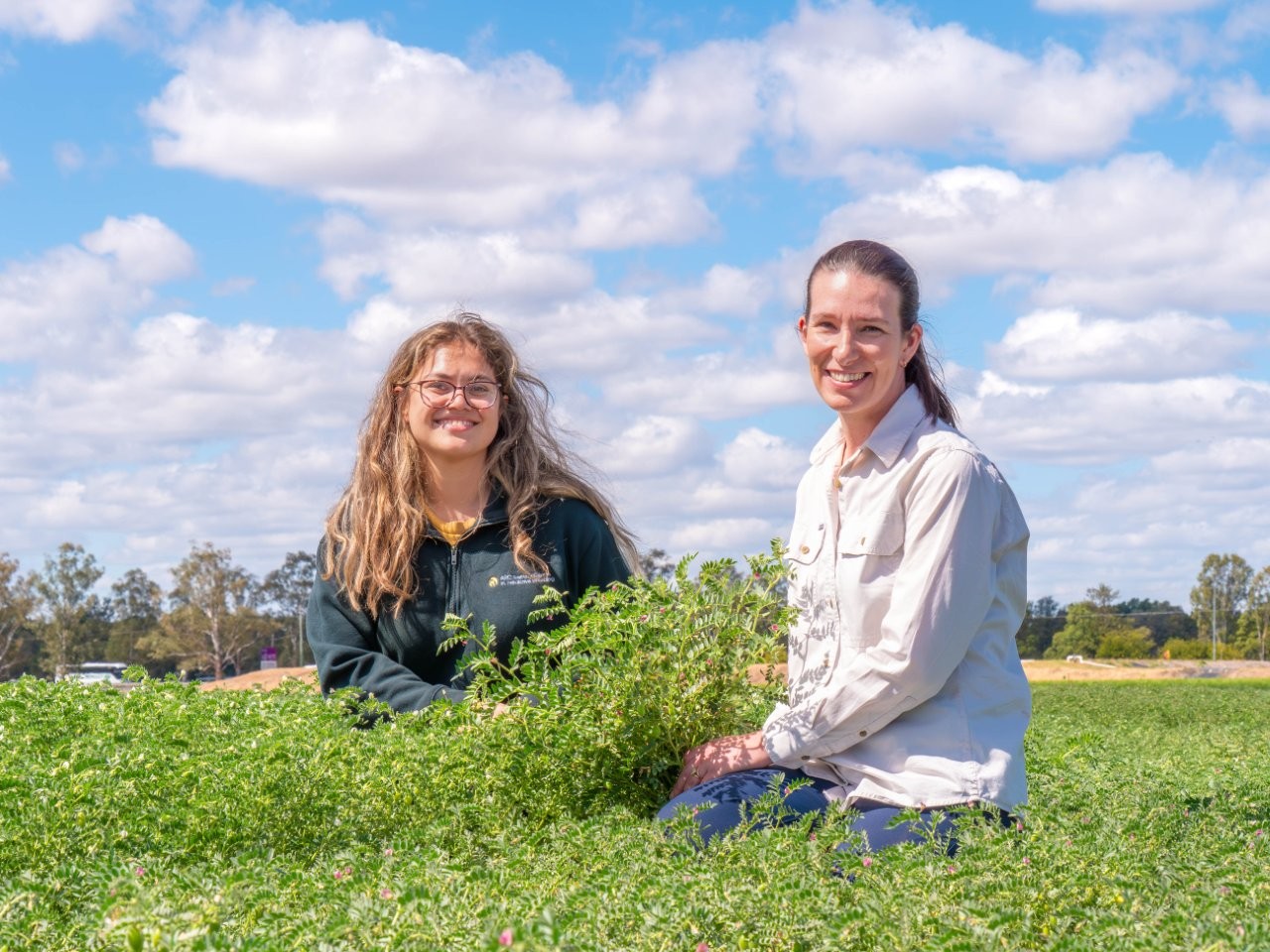
Dr Shanice Van Haeften (left) and Dr Millicent Smith (right) in a chickpea crop in southern Queensland. Image by Megan Pope UQ.

Fig. 1 An overview of legacy-focused crop breeding
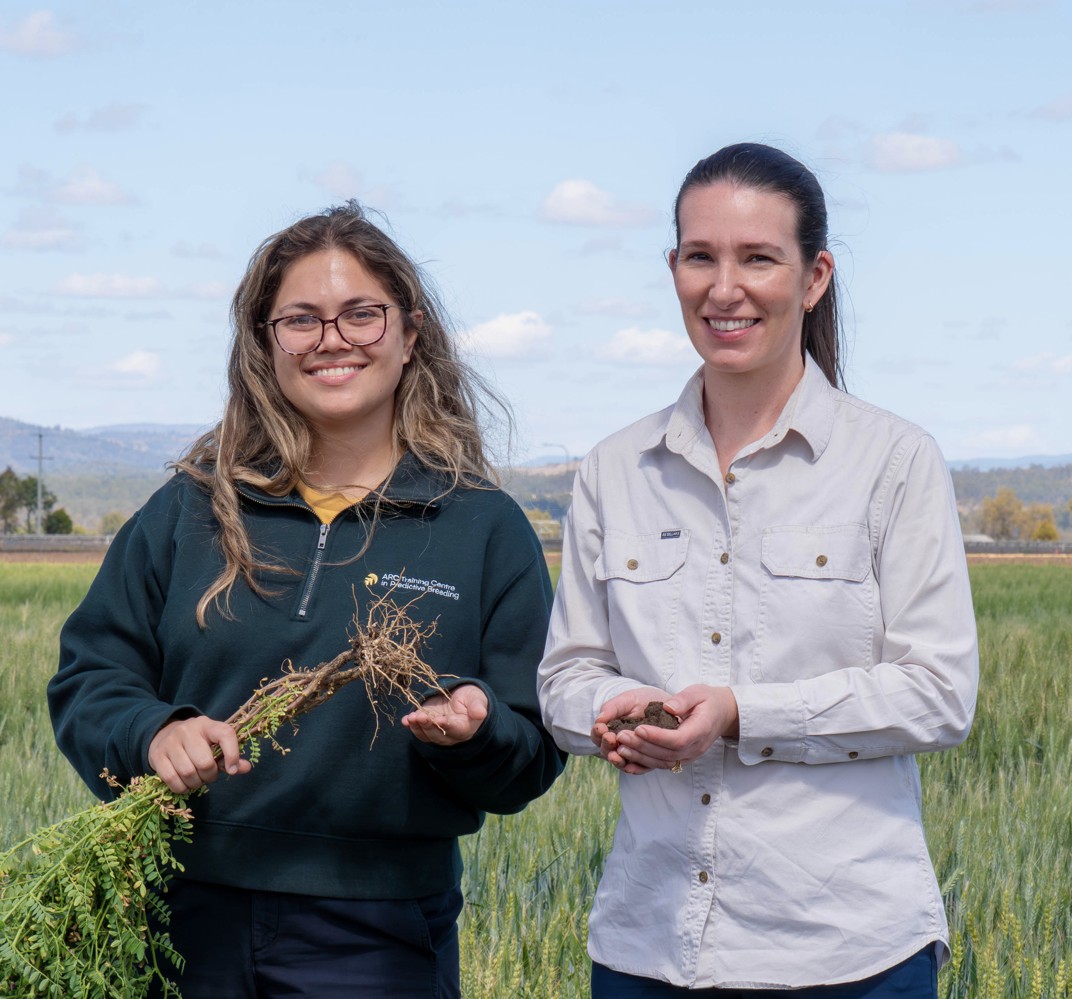
UQ Dr Shanice Van Haeften and Dr Millicent Smith with chickpea plant at UQ Gatton farm
Breeding crops for farming systems could cut fertiliser costs and lift yields. UQ research found crop varieties can boost following wheat yields by up to 1 t/ha
This new way of thinking about crop breeding has been set out by researchers at The University of Queensland.
Dr Millicent Smith said the idea was to select varieties for what they left behind for the next crop, not just for what they produced.
“We already know that every crop leaves a legacy, such as altered soil nutrients, water, structure, and microbial communities,” Dr Smith said.
“Rotating crops has delivered agronomic benefits for centuries, yet the genetics underpinning those benefits have remained largely invisible to plant breeding.”
Dr Smith’s team is treating rotation as a genetic question, rather than a management one.
“Growers choose which crop follows which. What we are saying is that the variety chosen matters too and could be something breeders select for,” she said.
Testing this theory has already shown remarkable results, with wheat yields varying by up to 1 tonne per hectare.
In a first-of-its-kind experiment, the project team grew more than 300 genetically diverse mungbean types at a research station in southern Queensland and then planted the same wheat variety across all the plots.
“Some mungbeans lifted the following wheat by 45 per cent, while others halved it,” Dr Smith said.
Based on these results, the research team believes it is possible to breed crops in an integrated way.
Plant breeder and crop geneticist Professor Lee Hickey said the team can now point to specific regions of the mungbean genome that influenced how well the following wheat crop performed.
“What’s striking is that some of those regions work against each other, the genetics that make one crop high yielding can be the same genetics that leave less soil resources behind for the next crop.”
The team also simulated what would happen if selection was applied equally to both mungbean yield and the subsequent wheat yield.
“That showed gains in both crops, highlighting the opportunity to breed for system-level productivity with reduced input requirements,” Dr Hickey said.
Dr Smith said the findings needed to be tested more broadly.
“We’ve shown the effect is real and heritable, but we don’t know yet what is driving it. The next step is understanding the biology behind it and that will require a community effort,” she said.
“While we have worked with mungbean and wheat, the same logic applies to other rotations including canola and wheat or chickpea and barley.
“We now know genetic variation is there, and the tools have finally caught up to allow us to investigate at the population scale required for crop breeding.
“We have drones, genomics, crop models, and the computing power to tie it together.
“It is a very exciting time to start thinking about breeding for the farming system.
“Every crop leaves a legacy, and we think it’s time we started harnessing it.”
The research was published in Plant Communications and Nature Genetics.
Media contacts: Dr Millicent Smith, millicent.smith@uq.edu.au, M +61 412 617 567; or Professor Lee Hickey, l.hickey@uq.edu.au, M +61 408 210 286; or UQ media Carolyn Martin 0439 399 866 carolyn.martin@uq.edu.au
PDF of paper, photos and video footage available from Dropbox
The Queensland Alliance for Agriculture and Food Innovation is a research institute at The University of Queensland, established with and supported by the Department of Primary Industries.
Citations:
Van Haeften, S., Brunner, S.M., Dinglasan, E., Fabreag, E., Eyre, J., Mens, C., Hayes, B.J, Udvardi, M., Alahmad, S., Eglinton, M., McQuinn, R., Ryan, M., van der Meer, S., Smith, M.R., Hickey, L.T., Genetic legacy effects in a mungbean-wheat rotation reveal potential to breed for system-level yield gains, Plant Communications, 2026, 102081, ISSN 2590-3462, https://doi.org/10.1016/j.Plant Communicationsxplc.2026.102081
Van Haeften, S., Brunner, S.M., Hayes, B.J. et al. Crop legacies as genetic targets for sustainable farming systems, Nature Genetics (Nat genet), 2026, ISSN 1546-1718 https://doi.org/10.1038/s41588-026-02744-2
Dr Millicent Smith
The University of Queensland
+61 412 617 567
millicent.smith@uq.edu.au
Visit us on social media:
LinkedIn
Facebook
YouTube
Breeding for better rotations opens a new frontier in farming systems. A new way of crop breeding set out by University of Queensland researchers.
Legal Disclaimer:
EIN Presswire provides this news content "as is" without warranty of any kind. We do not accept any responsibility or liability for the accuracy, content, images, videos, licenses, completeness, legality, or reliability of the information contained in this article. If you have any complaints or copyright issues related to this article, kindly contact the author above.
